Thanksgiving’s Christian Roots Traced Through History
Explore the religious origins of Thanksgiving, from colonial times to modern observances.
2 min read
President Donald Trump has proclaimed Thursday, Nov. 26, 2026, a National Day of Thanksgiving, emphasizing the Pilgrims’ faith in Jesus Christ and America’s divine providence. This declaration continues a tradition rooted in Christian gratitude that dates back centuries.
A Religious Tradition with Deep Roots
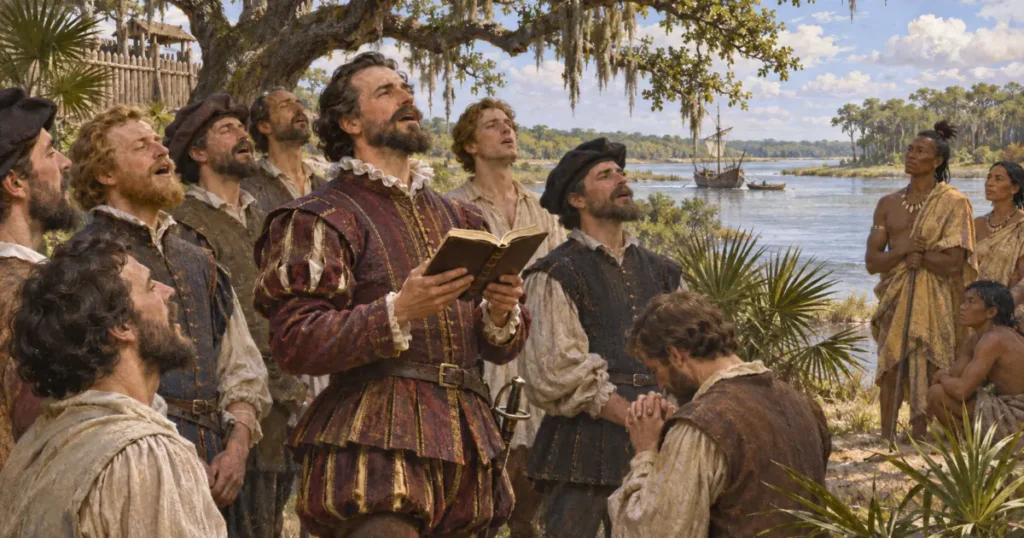
The practice of giving thanks to God predates the Pilgrims’ 1621 harvest celebration. Both Catholics and Protestants held thanksgiving observances in colonial America, often linking their religious beliefs to the founding of English colonies. The earliest recorded thanksgiving service occurred in Florida in 1564, when French Huguenots under René de Laudonnière celebrated a feast with the Timucua people, singing a psalm of gratitude.
Just a year later, in 1565, Spanish settlers in St. Augustine held a Mass of thanksgiving on the feast of the Nativity of the Blessed Virgin Mary. This event, described by the National Park Service as the first community act of religion and thanksgiving in North America, marked a significant moment in the religious history of the continent.
Colonial Foundations and Religious Commitments
The English also embedded their religious aims in their colonial charters. The First Charter of Virginia, issued in 1606, named the propagation of the Christian religion as one of the colony’s main purposes. In Virginia, the investors behind Berkeley Hundred ordered that the day of the ship’s arrival be kept as a day of thanksgiving to Almighty God, a tradition that continued for generations.
The Pilgrims, too, were deeply religious. In 1620, they signed the Mayflower Compact, declaring their voyage was “for the Glory of God and Advancement of the Christian Faith.” Their 1621 harvest celebration, documented by Edward Winslow, was a joyous occasion marked by gratitude for God’s goodness and the presence of the Wampanoag leader Massasoit.
From Local Observances to National Tradition
Thanksgiving evolved from local religious observances to a national tradition. During the Revolutionary War, the Continental Congress set aside Dec. 18, 1777, as a day of thanksgiving, calling on Americans to “adore the superintending providence of Almighty God.” In 1789, George Washington issued the first national Thanksgiving proclamation, a practice continued by Abraham Lincoln during the Civil War.
Today, Trump’s proclamation echoes the sentiments of past leaders, calling on Americans to gather in their homes and places of worship to give thanks to God. This practice, rooted in colonial history, has become a cornerstone of American culture, reflecting the nation’s deep religious heritage.
Source: The Gateway Pundit