Colombia’s New Leader Launches Mega-Prison to Crack Down on Gangs
Colombia’s new right-wing president inaugurates a mega-prison to tackle organized crime, echoing El Salvador’s Bukele strategy.
5 min read
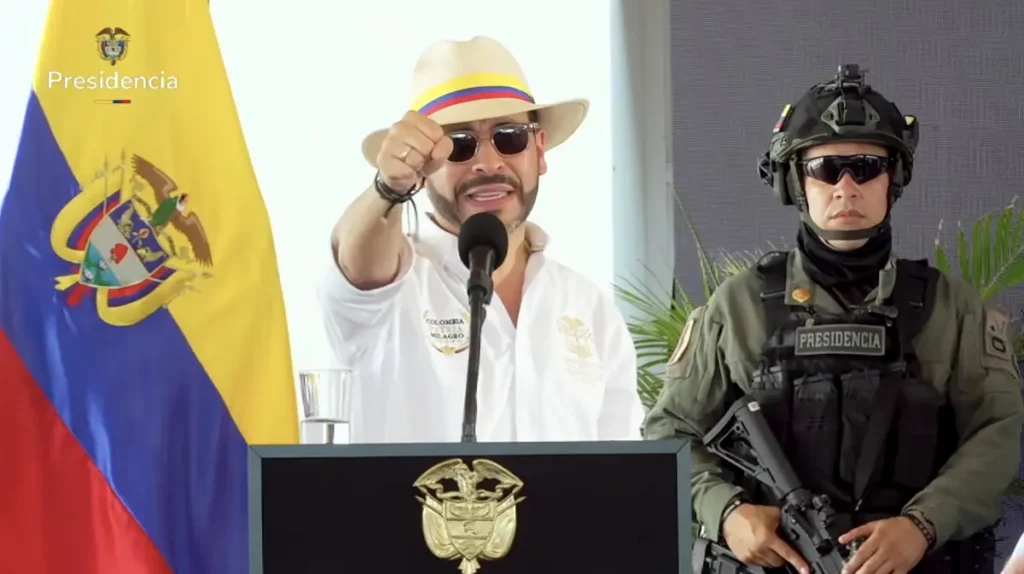
Colombia’s newly elected right-wing President Abelardo de la Espriella, known as ‘El Tigre,’ has taken a significant step in his campaign to overhaul the country’s security approach by inaugurating the first ‘mega-prison’ in Riohacha, La Guajira. The facility, which marks a major shift in Colombia’s strategy against organized crime and prison security, is a direct response to the persistent challenges of gang activity and criminal operations within the prison system.
Iron-Fisted Approach to Crime
The inauguration of the prison, which features 476 cells and can accommodate 1,722 inmates, underscores de la Espriella’s commitment to a ‘tough-on-crime’ strategy. The facility, spanning nearly 25 acres, represents an investment of over 362 billion Colombian pesos and is the first major prison infrastructure project completed in Colombia since 2011. Construction began in 2021 but faced delays for four years before the current administration brought it to completion.
De la Espriella emphasized that expanding prison capacity is only one component of his broader offensive against organized crime. He has made it clear that dismantling the criminal networks that continue to operate from inside Colombia’s prisons is a top priority. During his inauguration speech, the president stated, ‘My first duty as President of Colombia is to protect the life, the liberty and the peace of Colombians.’ He further declared, ‘Enforcing the law with an iron fist, as it should be.’ De la Espriella also vowed to ensure that criminals cannot continue to run their operations from prison cells, stating, ‘What cannot happen is that a criminal keeps running a criminal organization from a prison, from a cell!’ The president concluded his remarks with a rallying cry, ‘Today more than ever, I stand firm for the security of Colombians and firm for the homeland. Long live Christ the King!’
Strengthening Prison Security Measures
In addition to the construction of the mega-prison, de la Espriella has ordered the national prison authority, INPEC, to implement tighter security measures to prevent inmates from obtaining unauthorized cellphones. According to Caracol Radio, the president also mandated an investigation into prison personnel who may be facilitating the smuggling of communication devices into correctional facilities. Officials found complicit in such activities could face criminal prosecution. This crackdown targets a critical issue: incarcerated criminals who continue orchestrating extortion schemes, threatening innocent citizens, and ordering murders while supposedly under government custody.
What good is putting a gang leader behind bars if he can continue directing his criminal empire from the comfort of his prison cell? The Riohacha facility, classified as a medium-security penitentiary, includes rehabilitation, educational, and healthcare facilities, according to Colombia’s Ministry of Justice. While the focus is on incarceration, the government is also emphasizing the importance of rehabilitation and support systems for inmates to reduce recidivism and improve outcomes for those reintegrating into society.
Comparisons to El Salvador’s Bukele
The move draws obvious comparisons to El Salvador’s President Nayib Bukele, whose sweeping crackdown on violent gangs has attracted international attention. De la Espriella has already drawn comparisons to Bukele in previous actions, such as the relocation of 20 high-risk inmates from prisons in Barranquilla as part of an effort to dismantle criminal operations behind bars. Spanish newspaper El País reported that De la Espriella has also proposed constructing 10 mega-prisons in remote areas of Colombia to house some of the country’s most dangerous criminals. These plans reflect a broader strategy to isolate and neutralize the most dangerous elements of organized crime.
🚨 WOW! Colombia’s new right-wing President Abelardo de la Espriella just went full NAYIB BUKELE MODE, opening his government’s first MEGA-PRISON — vowing to end gangs running crime from their cells
Political Shift and Context
De la Espriella’s inauguration marks a significant political shift in Colombia following the administration of leftist President Gustavo Petro. His victory in the June presidential election signals a move toward a more conservative and security-focused approach to governance. The Gateway Pundit has previously covered Bukele’s crackdown on criminal gangs, including the construction of El Salvador’s massive 40,000-capacity Terrorism Confinement Center, better known as CECOT. Bukele’s policies have coincided with a dramatic decline in homicides, although his administration has also faced international criticism over due process and detention conditions.
Colombia now appears to be pursuing its own version of the tough-on-crime approach, inspired by Bukele’s strategies. The new president’s focus on prison infrastructure and security measures is part of a broader effort to address the root causes of organized crime and ensure that the prison system is not being used as a platform for criminal activity. The success of this initiative will depend on the effectiveness of the security measures implemented and the ability to prevent the smuggling of communication devices into prisons.
Challenges and Future Outlook
Despite the ambitious plans, the implementation of these measures will face several challenges. The construction of the mega-prison and the associated security upgrades require significant resources and coordination. Additionally, the government must navigate the complex legal and ethical considerations of increasing prison security while ensuring that the rights of inmates are protected. The international community will be closely watching the outcomes of these policies, particularly in light of the criticisms faced by Bukele’s administration.
As Colombia moves forward with its security overhaul, the focus will remain on dismantling criminal networks and ensuring that the prison system is a tool for justice rather than a haven for organized crime. The success of de la Espriella’s initiatives will be a critical factor in shaping the future of Colombia’s approach to crime and public safety.
Source: The Gateway Pundit