Thanksgiving Feast Explained Through Economic Theory
How a national tradition of feasting aligns with Ronald Coase’s economic theory of coordination.
2 min read
Why do millions of Americans gather each year for a Thanksgiving feast, despite differences in culture, politics, and schedules? The answer lies in an economic theory that explains how coordination problems are solved through shared traditions and predictable routines.
The Coordination Problem
Americans are a diverse group with varying preferences, schedules, and backgrounds. From thermostat settings to work demands, our lives are shaped by individual choices. Yet, on the fourth Thursday of November, a remarkable number of us gather for a shared meal, often featuring a roasted turkey.
Ronald Coase and the Nature of the Firm
Ronald Coase’s 1937 essay, The Nature of the Firm, offered insight into why firms exist. While prices can coordinate production, the process of finding workers, negotiating contracts, and managing projects can be costly. Coase argued that in some cases, it is more efficient to organize production internally rather than rely on market mechanisms.
Thanksgiving as a Coordination Mechanism
Applying Coase’s theory to Thanksgiving, the holiday functions as a form of economic coordination. With a fixed date and shared expectations, families and friends can plan meals and gatherings without the need for extensive negotiation. No one is expected to answer emails or attend meetings, allowing for a break from the usual demands of daily life.
The Turkey: An Equalizer
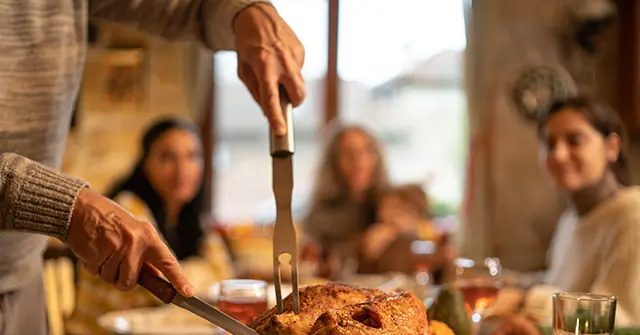
Turkey, the centerpiece of the feast, serves as an equalizer. While there are variations in preparation, the standard well-cooked turkey is a common experience for all. This uniformity reduces the pressure to outdo one another and allows for a sense of shared tradition.
Planning and Predictability
Planning for Thanksgiving is simplified by the predictability of the event. With a fixed date and a well-known main course, families can focus on bringing their own side dishes and contributions without the need for a formal menu. This allows for a great deal of improvisation and personal expression.
Setting Boundaries
Just as firms have limits, Thanksgiving hosts also set boundaries. While it is reasonable to prepare the main dish and make the gravy, not every detail needs to be perfect. Similarly, while it is meaningful to gather with family, the holiday is not an excuse to bring the entire neighborhood together.
Gratitude and Tradition
Thanksgiving, in all its simplicity, is a remarkable achievement. It brings together millions of people across the country, united by a shared tradition and a sense of gratitude. It is a reminder of the power of coordination, even in a world where consensus is hard to find.
Happy Thanksgiving. Bring a pie. Or better yet, a bottle of wine.
Source: Breitbart