Midterms Could Shape 2028 Election Rules in Key States
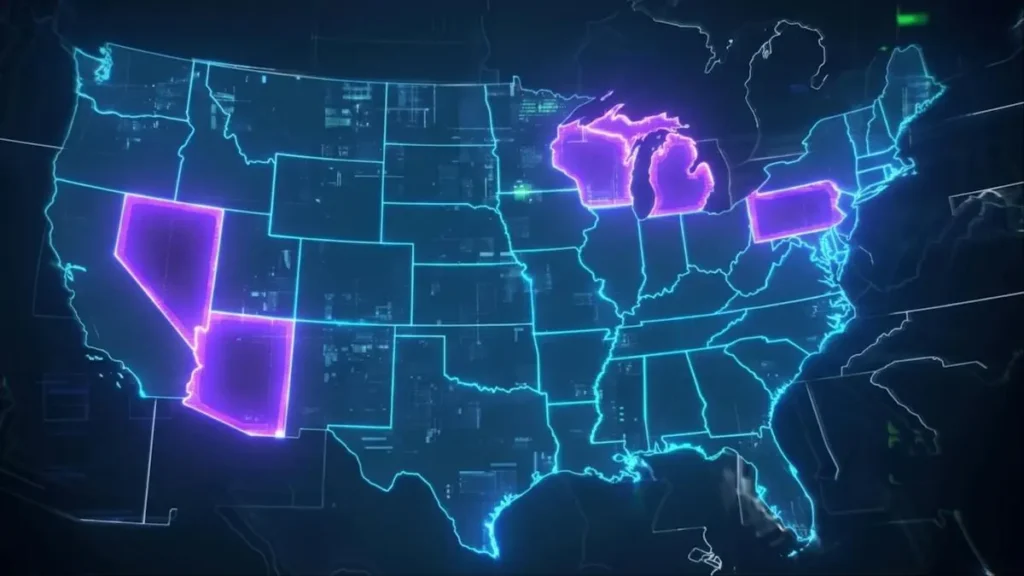
Midterm races in five battleground states could reshape voting rules and impact future presidential elections, according to a new report.
4 min read
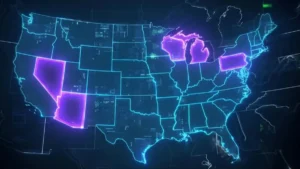
As the 2024 midterm elections approach, the stakes extend beyond the control of Congress, with significant implications for the 2028 presidential race. The Honest Elections Project, a conservative watchdog group, has warned that the outcomes in five key battleground states—Arizona, Michigan, Nevada, Pennsylvania, and Wisconsin—could redefine election rules and fundamentally alter the landscape of future presidential elections.
The Power of State Control
The report, obtained by The Daily Wire, highlights how a shift in power to Democrats in these states could lead to a ‘Democrat trifecta,’ giving them control of all three branches of state government. This would allow for rapid implementation of voting reforms that could significantly impact the Electoral College and the structure of future presidential elections.
Currently, these states are divided in governance, with at least one branch controlled by each major party. Only Nevada has a Republican governor, while Arizona and Pennsylvania are led by Democrats. In Michigan, Governor Gretchen Whitmer is term-limited, and in Wisconsin, Governor Tony Evers is not seeking re-election. The report warns that a Democratic sweep in these states could lead to immediate changes in voting laws, similar to what happened in Virginia after Democrats took control in 2026.
Virginia’s Example: A Blueprint for Reform
The report cites Virginia as a case study, where Democrats passed significant voting reforms after securing a trifecta. These included expanding ranked-choice voting, relaxing mail-in voting standards, and joining the National Popular Vote Interstate Compact. This compact, which aims to replace the Electoral College with a national popular vote system, has already been signed by over a dozen Democratic-leaning states. If enough states join, the compact would take effect, effectively neutralizing the Electoral College and shifting power to larger, more urban areas.
The report notes that the compact requires 270 electoral votes to take effect, and with the potential for a Democratic trifecta in Pennsylvania, Michigan, and Arizona alone, the compact could reach 267 votes. Either Wisconsin or Nevada would then complete the 270 threshold before the 2028 presidential election. This scenario could permanently alter the way presidential elections are conducted in the United States, favoring larger states and metropolitan areas.
State Laws and Voting Rights
The report also analyzed the 419 election-related bills passed into law across the country by August 2026. Of these, 223 were passed by states with Republican control, focusing on citizenship verification, voter roll accuracy, and voter ID provisions, while 158 were passed by Democratic-controlled states, including automatic voter registration and relaxed mail-in voting laws.
Democratic reforms are described as pushing the election rules out of legislatures and into court, with automatic registration adding names to the rolls without voter consent and often without adequate verification. Mail-in voting, meanwhile, is seen as moving voting out of supervised settings and into the hands of the postal service. These changes could potentially increase voter participation but also raise concerns about the integrity and accuracy of election results.
Legislative Deadlock at the Federal Level
Despite the significant state-level activity, federal lawmakers have made little progress on election reform. Legislation backed by former President Donald Trump, which would have required proof of citizenship to vote in federal elections, passed the House earlier this year but stalled in the Senate. This legislative deadlock highlights the challenges of enacting comprehensive voting reforms at the federal level, leaving state legislatures as the primary arena for shaping election rules.
Implications for the 2028 Election
The report warns that the changes in state voting laws could have far-reaching implications for the 2028 presidential election. If Democrats secure control in the five key states, they could implement reforms that favor their base, such as expanding mail-in voting and ranked-choice voting. These changes could alter the electoral landscape, making it more difficult for candidates to win based on traditional state-by-state outcomes and instead favoring a national popular vote system.
Additionally, the report notes that the National Popular Vote Interstate Compact, if fully implemented, could undermine the Electoral College and shift the focus of presidential campaigns to urban areas with large populations. This could lead to a more evenly distributed electorate, potentially favoring candidates with broad national appeal over those with strong regional support.
Conclusion: The Future of Election Integrity
The Honest Elections Project’s report underscores the critical role that state-level elections play in shaping the future of American democracy. The outcomes in the five battleground states could set a precedent for how future presidential elections are conducted, with significant implications for voter access, election integrity, and the balance of power between states and the federal government. As voters prepare to cast their ballots, the decisions made in these states could have lasting effects on the democratic process in the United States.
Source: Daily Wire