Polish Supreme Court Blocks Liberal Takeover of Constitutional Tribunal
Polish Supreme Court rejects liberal attempt to seize control of Constitutional Tribunal, escalating political tensions.
2 min read
In a significant political development, the Polish Supreme Court has ruled against efforts by Prime Minister Donald Tusk’s allies to unilaterally take control of the Constitutional Tribunal, a key judicial body in the country. The court’s decision marks a critical moment in the ongoing power struggle between liberal and conservative factions in Poland.
Political Conflict Over Judicial Appointments
The dispute centers on the appointment of judges to the Constitutional Tribunal, which is considered the highest court in Poland concerning matters of law. Prime Minister Donald Tusk, a member of the liberal Civic Coalition (KO), has been attempting to replace conservative judges with liberal appointees, a move that has been strongly opposed by President Karol Nawrocki, a conservative leader aligned with the Law and Justice (PiS) party.
President Nawrocki refused to swear in any new judges appointed by the Tusk-controlled Sejm parliament, leading to a prolonged political standoff. The situation escalated when liberal justice Anna Korwin-Piotrowska ordered the suspension of conservative court president Bogdan Święczkowski and his vice president Bartłomiej Sochański, declaring herself the new head of the tribunal.
Confrontation and Legal Battle
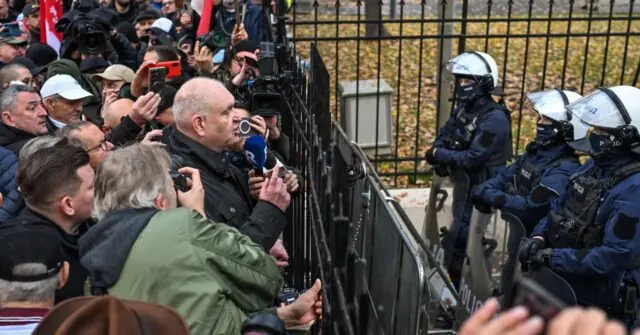
Święczkowski, who is aligned with the opposition PiS party, rejected the suspension and claimed he was still the legitimate head of the Constitutional Tribunal. The situation reached a dramatic peak on October 30th when riot police were deployed to the tribunal building to prevent Święczkowski from entering. President Nawrocki, who had been on a diplomatic trip to Senegal, returned to Warsaw and stormed the building, denouncing those inside as lacking legal authority.
Despite the Supreme Court initially ruling it had no jurisdiction over the case, the decision was later overturned, and the court ultimately ruled that Święczkowski and Sochański should be restored to their positions. However, Korwin-Piotrowska rejected the ruling, claiming the Supreme Court did not have the authority to overrule the suspensions.
Broader Implications and Election Outlook
The dispute has broader implications for the political landscape in Poland, with a general election looming next year. Tusk is reportedly seeking to stack the Constitutional Tribunal to weaken a potential conservative government. Polls suggest that conservative parties, including PiS and Development Plus, are on track to win a majority of the vote, signaling a potential shift in power.
With the political climate increasingly polarized, the outcome of this dispute could have lasting effects on Poland’s judiciary and its political future.
Source: Breitbart