Sharia Intimidation Grows in Europe Amid Political Islam Push
Emails warning of explosives and Sharia demands highlight rising political Islam threats in Europe.
5 min read
Political Islam’s reply to a free society is not to join with freedom in mind. On a Monday morning, a flood of emails titled “Death awaits you” landed across Denmark and in hundreds of schools in Germany. The subject line was identical everywhere. The message claimed explosives had been planted in the school buildings and demanded that the government fall and Islam’s Sharia take its place.
Police quickly ruled the threats hoaxes. No devices were found. Yet the content was not random, and neither was the timing. The emails arrived the day after Danish Prime Minister Mette Frederiksen said aloud what many European leaders still prefer to soft-pedal: that supporters of Hamas, advocates of Sharia, and those who place the Quran above democratic law form an enemy growing inside the open Western society.
The Pattern of Intimidation
This is what political intimidation looks like. It does not always need a successful bombing. It needs only to announce that certain speech carries a price, that the secular order is provisional and standing on shaky ground, and that the proper end state is religious law for Allah’s sake.
The Danish episode is a small window onto a larger pattern, visible across Western Europe for at least three decades. Watch the sequence, which repeats with depressing regularity. When Muslim communities are small, the public posture is vulnerability and an appeal to Western tolerance. Discrimination, we are told, must be fought. Religious freedom must be protected. Integration — wait for it — is pursued and presented as the shared goal.
As Muslim numbers grow and communal confidence rises, the demands shift. Prayer rooms and halal options become non-negotiable. School calendars and workplace rules are expected to bend. Criticism of Islamic doctrine, of Muhammad’s example, or of the Quran’s “claimed” superiority is recast as bigotry, branded with the weaponized buzzword “Islamophobia.” Parallel social norms take root in neighborhoods. Severe pressure, applied through family and community, falls on those who dare to leave Islam or who speak or “live” too freely.
The Legal and Political Transformation
In time, explicit challenges arise to the supremacy of secular law itself, whether through agitation for Sharia in family matters, resistance to the equal application of criminal law, or political mobilization that treats the non-Muslim constitutional order as secondary to religious obligation.
The West has watched this for years. Is it time to wake up and speak about it?
This progression is unique to Islam. Other religious and cultural communities have settled in the West in significant numbers without generating the same sustained project of legal and political transformation. The difference lies in Islam’s worldview. In its classical formulation, Islam is not a private faith. It is worship and political leadership fused together. If Muhammad was, for Muslims, both prophet and battlefield commander, then the logic follows that Islam is a comprehensive religiopolitical system. Sharia is not a set of personal spiritual disciplines. It is a claim on public life, on governance, and on the proper ordering of society. And Sharia is not only for Muslims. It speaks precisely to non-Muslims as well, specifying their social and legal status, and that status is inferior.
The Role of Liberal Societies
The concepts of expansion, of a world divided into realms of Islam and unbelief, and of the duty to elevate Allah’s law over man-made law remain alive in Islamic political thought. Groups such as Hamas and the Muslim Brotherhood make no secret of it. They fuse religious authority, political power, and the rejection of liberal democratic norms into a single program. When that program travels with migration and finds the demographic room to assert itself, the earlier language of victimhood and accommodation becomes a platform for something more ambitious.
Now back to the intimidation of Denmark and Germany. Liberal societies hand political Islam a useful set of tools. Freedom of religion is invoked to widen the public reach of Muslim norms. Freedom of expression is defended when it serves Islam’s hegemony and contested when it permits scrutiny of Islamic texts, history, or practices. Equality before the law is demanded for Muslims as a group, while parallel norms that treat women, apostates, and critics unequally are shielded from the same standard.
The Consequences of Intimidation
The result? The open society’s own principles are turned into instruments for narrowing the space in which those principles can be defended.
The Muslim intimidation works on several levels at once. There is the direct threat, the email that tells a school principal or a cartoonist that death awaits. And there is the ambient pressure that makes publishers, teachers, and politicians think twice before questioning Islam or Muhammad’s character, lest they cross a line no one will name but everyone can feel and should fear.
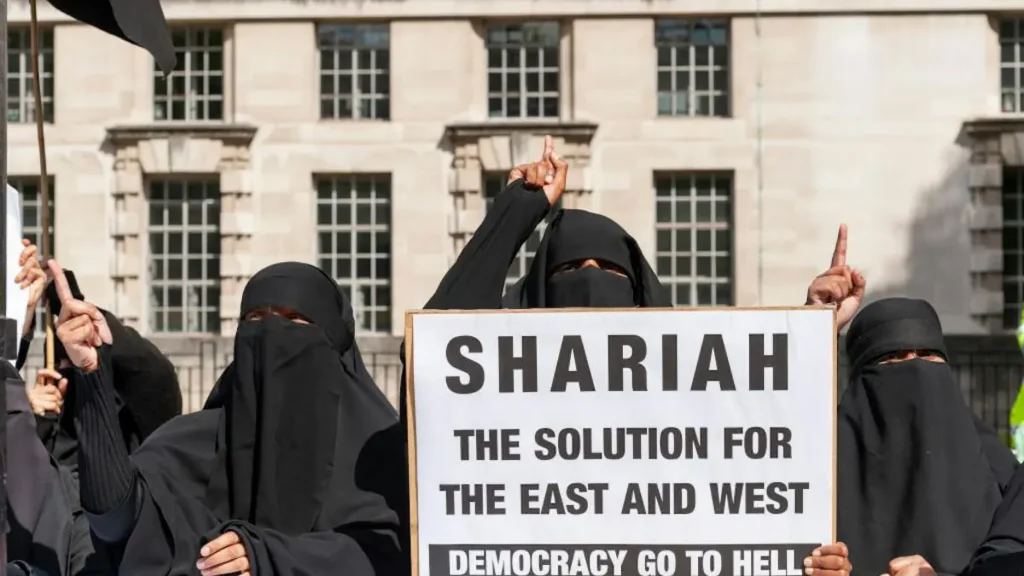
Of course, not every Muslim is a closet political Islamist. But the political and legal claims of Islam’s so-called “sacred” texts find enough adherents, enough organizational strength, and enough hesitation from the host society to advance.
The Call for Clarity
The Danish threats were a message written in the clearest possible language. When a European leader names the problem, whether Hamas supporters, Sharia advocates, or the claim that the Quran outranks the constitution, the reply can arrive the next morning in the inboxes of schools.
The proper response is neither panic nor denial, but absolute clarity: Political Islam is not a partner in liberal democracy. It is a competitor to it, a vicious ideology that seeks to replace and suppress Western norms. Free societies that forget this eventually discover the cost in the erosion of the very freedoms they imagined were permanent.
Source: Daily Wire