Desert Shield and Desert Storm Memorial Unveiled on National Mall
35 years after the Gulf War, a new memorial honors U.S. and coalition forces on Washington’s National Mall.
3 min read
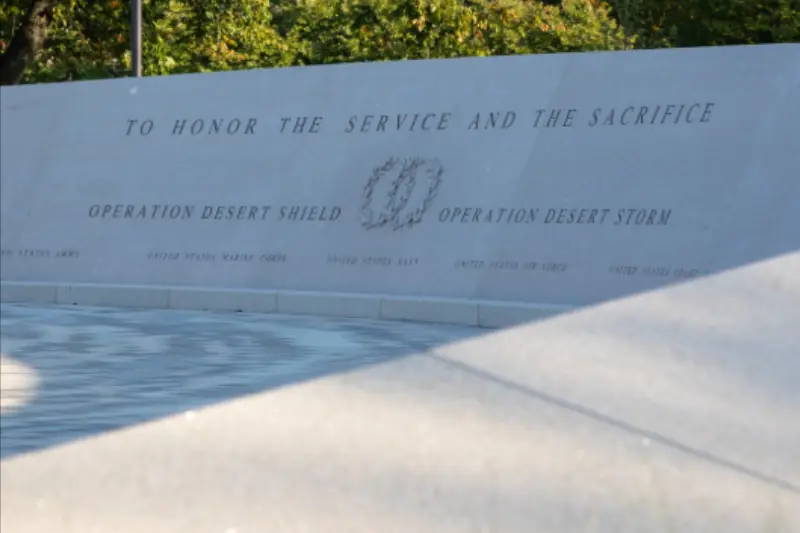
Thirty-five years after coalition forces liberated Kuwait from Saddam Hussein’s Iraqi invasion, the Desert Shield and Desert Storm Memorial has officially opened on the National Mall in Washington, D.C. The Gulf War (1990-91) was fought by a coalition of dozens of countries led by the United States in response to the Iraqi invasion of Kuwait. It included the months-long military buildup in Saudi Arabia known as Operation Desert Shield and the 43-day war against the occupying forces called Operation Desert Storm.
After weeks of bombardment against Iraqi forces, the coalition launched a ground offensive, achieving victory within days and liberating the Gulf nation of Kuwait. The memorial, developed by the National Desert Storm Memorial Association, is now open at the National Mall, near the Vietnam Veterans Memorial and the Lincoln Memorial.
On Saturday, the opening ceremony for the long-awaited memorial commenced with Gulf War veterans in attendance. The ceremony included the Army Band’s performance of the U.S. national anthem and the Kuwaiti national anthem, as well as the raising of the American flag over the monument, according to Stars and Stripes.
Today, the Desert Shield and Desert Storm Memorial joins the National Mall’s living history. 35 years after these operations, the memorial provides a permanent place to honor the service and the sacrifice. pic.twitter.com/oNBM94hLWt
“Today, the Desert Shield and Desert Storm Memorial joins the National Mall’s living history,” National Mall said in a statement on X. “35 years after these operations, the memorial provides a permanent place to honor the service and the sacrifice.”
On Saturday, the Desert Shield and Desert Storm Memorial opens in Washington, D.C., honoring the courage and sacrifice of American servicemembers who answered the call to defend freedom and helped liberate Kuwait. Their service will never be forgotten. pic.twitter.com/j5miB7VOPp
“On Saturday, the Desert Shield and Desert Storm Memorial opens in Washington, D.C., honoring the courage and sacrifice of American servicemembers who answered the call to defend freedom and helped liberate Kuwait,” The U.S. Department of Interior said on X. “Their service will never be forgotten.”
Under the federal law authorizing the memorial, no taxpayer dollars were used for its design or construction. Instead, the roughly $40 million project was funded entirely through private and foreign donations, including a substantial contribution from the government and people of Kuwait. While the federal government provided the land on the National Mall near the Lincoln and Vietnam Veterans memorials, the law required organizers to raise 110% of the estimated cost before breaking ground to ensure both construction and long-term maintenance were fully covered.
“This memorial represents many forms of sacrifice: those who gave their lives in theater, those who passed away later from related causes, and those still carrying the physical and emotional toll of their service,” the memorial website stated. Unlike the Vietnam Veterans Memorial, the Desert Shield and Desert Storm Memorial does not list the individual names of those who lost their lives during the war. The memorial’s website cites two reasons for the omission: legislative constraints and the desire to leave a different legacy.
During the conflict, U.S. and coalition forces suffered around 300 to 380 total deaths, depending on official tracking windows. This includes 148 U.S. combat deaths alongside roughly 150 non-battle casualties from accidents or illness, according to the Defense Casualty Analysis System. Following the coalition victory in the Gulf War, Saddam Hussein remained in power until the 2003 U.S.-led invasion of Iraq, when he went into hiding before being captured by American forces in a subterranean hideout near Tikrit in December 2003. He was subsequently tried by an Iraqi tribunal for crimes against humanity, convicted and executed by hanging in Baghdad in December 2006.
Source: OANN