Anti-Israel Activist Wreaks $60M Damage on U.S. Military Plane
An Irish national is charged with destroying a $60 million U.S. military aircraft after a months-long campaign of sabotage.
5 min read
Daithi O’Corrain, an Irish national, has been charged with destroying a $60 million U.S. military aircraft after a months-long campaign of sabotage. The incident, which unfolded at Ireland’s Shannon Airport, has drawn significant attention due to the scale of the damage and the deliberate nature of the attack.
Attack on U.S. Military Aircraft
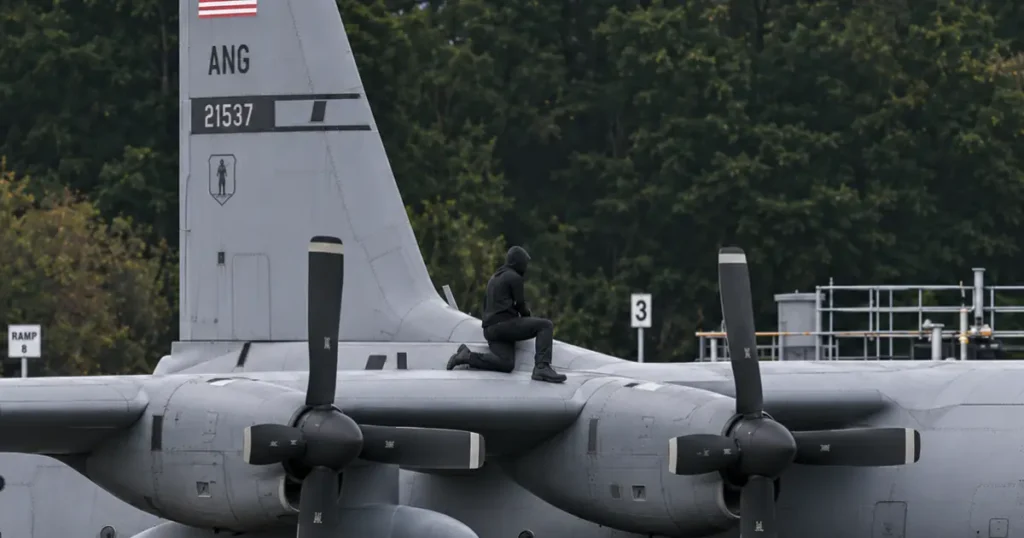
On April 11, O’Corrain broke into Shannon Airport, a major transatlantic hub for U.S. military troops and equipment, according to a U.S. Department of Justice news release. He then sought out a U.S. Air National Guard C-130 Hercules plane parked on the taxiway, breaking into it through its rear crew door and barricading himself inside using an assortment of tools and supplies he had brought with him.
Inside the aircraft, O’Corrain proceeded to inflict severe damage to the interior. He reportedly cut wire bundles and hydraulic lines, crimped a liquid oxygen line, wrecked every gauge in the cockpit, and punctured the plane’s air ducts. The Justice Department described the damage as extensive, with the use of gallium — a highly corrosive metal that is a liquid at room temperature — causing long-term corrosion to steel and immediate damage to aluminum.
Escalation and Capture
Several hours after the attack began, the plane’s flight crew returned to the airport and reportedly observed O’Corrain through the cockpit window. After alerting airport security, they witnessed him escape from a hatch on the plane’s roof and inflict further damage by using a hatchet or axe, as well as by tossing ball bearings into its fuel tanks.
This part of the attack was captured on film by bystanders, with
A man with a Hatchet made it through a security area and destroyed a $60 million U.S. Air National Guard C-130 Hercules in protest of the US war in Iran. Locked himself inside and cut wires and other Equipment was Damaged. Protesting the US war with Iran! https://t.co/mYjJBvDj4o
providing a visual record of the unfolding chaos. Law enforcement arrived at the scene shortly after and arrested O’Corrain, who has since been charged with destruction of government property, which carries a maximum sentence of 10 years in prison.
Context and Consequences
FBI Assistant Director in Charge James Barnacle, Jr. described the attack as a “deliberate, planned attack against a U.S. military aircraft,” emphasizing that the damage caused “tens of millions of dollars in damage and jeopardizing critical military operations.” He noted that O’Corrain allegedly spent months researching the aircraft, acquiring tools and materials, and preparing to maximize the destruction he could inflict. The FBI and its law enforcement partners are committed to pursuing anyone who targets U.S. military assets, regardless of where the attacks occur.
The damage inflicted by O’Corrain rendered the aircraft inoperable, and the plane, worth approximately $60 million, will not return to active flight status, according to the Justice Department. The incident has raised concerns about the security of U.S. military assets stationed abroad, particularly in light of recent evacuations of aircraft from two British air bases — RAF Fairford in September and October, as well as RAF Mildenhall in November — due to security threats and potential plots linked to Iran.
A U.S. official confirmed that several military aircraft had left RAF Mildenhall as the security posture there had increased, as reported by NBC News. The evacuation followed weeks after the U.S. withdrew bombers from another base in Britain, RAF Fairford, after police foiled a suspected terrorist plot linked to Iran. These developments underscore the heightened security concerns surrounding U.S. military installations and the potential for attacks by individuals with anti-U.S. or anti-Israel sentiments.
Support and Legal Defense
O’Corrain’s allies have launched a fundraiser on his behalf, with the stated purpose of supporting his legal defense. The fundraiser reveals that O’Corrain claims to have acted to “resist the unwanted presence of the US Military in Ireland in the face of their illegal war & support of Israel’s genocide.” This statement has drawn both support and condemnation, highlighting the polarized views surrounding the attack and its perceived motivations.
The incident has also sparked broader discussions about the role of anti-Israel activism in targeting U.S. military assets. While O’Corrain’s actions are legally and morally contentious, they have been framed by his supporters as a form of resistance against what they perceive as U.S. military overreach and support for Israel. This has further complicated the legal and ethical landscape of the case, as it intersects with issues of free speech, national security, and the use of violence as a form of protest.
Broader Implications
The attack on the U.S. military aircraft has had far-reaching implications, not only for the individuals involved but also for the broader context of international relations and security. The incident has reinforced the need for heightened security measures at U.S. military installations abroad, particularly in regions where tensions with Iran or other hostile actors are present.
Additionally, the case has raised questions about the legal and ethical boundaries of protest, particularly when it involves the use of violence against government property. While the First Amendment protects the right to protest, the use of violence is generally considered a separate and more serious offense. O’Corrain’s case has brought these issues to the forefront, prompting discussions about the limits of free speech and the responsibilities of individuals when engaging in acts of protest.
As the legal proceedings continue, the case will likely serve as a cautionary tale about the consequences of using violence as a form of protest, especially when it involves the destruction of government property. It also underscores the importance of maintaining the security of U.S. military assets, both domestically and abroad, in an increasingly complex and volatile global environment.
Source: The Gateway Pundit