China’s Tarmac Hug: A Strategic Move in Diplomatic Messaging
Xi Jinping’s tarmac hug with Trump sparks domestic narrative in China’s political theater.
5 min read
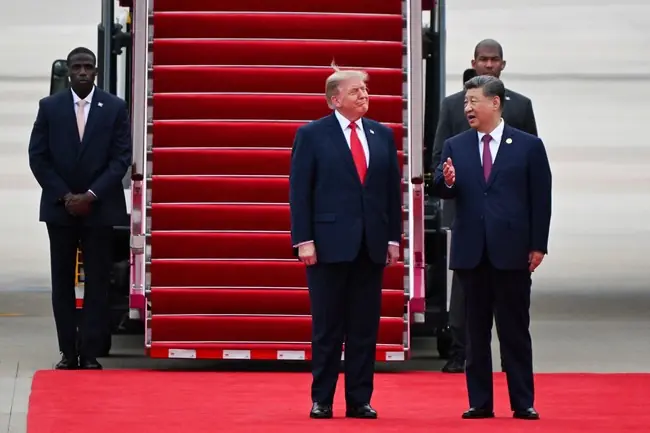
Chinese President Xi Jinping’s unscripted tarmac hug with U.S. President Donald Trump during a state visit to Shenzhen has become a focal point of domestic political messaging within China. The moment, captured by multiple media outlets, was not just a gesture of camaraderie but a calculated move in shaping the narrative for China’s domestic audience. The event unfolded on November 18, 2026, as Xi arrived at the airport, where he greeted Trump with a handshake and a brief embrace, a rare display of personal diplomacy from the Chinese leader. This gesture, described by analysts as a ‘rare personal move,’ was carefully orchestrated to reflect the broader themes of reciprocity and mutual respect that have long been central to China’s diplomatic approach.
Pageantry as Political Strategy
Xi’s tarmac greeting was not an isolated incident but part of a larger strategic narrative. The event marked the beginning of the Asia-Pacific Economic Cooperation (APEC) summit, where Xi played a central role in shaping the agenda. The summit, which brought together leaders from across the Asia-Pacific region, provided a stage for Xi to showcase China’s diplomatic influence and its commitment to multilateralism. The tarmac hug, which was broadcast widely on domestic media, was framed as a symbol of the ‘constructive’ and ‘stable’ relationship between China and the United States, a theme that has been consistently emphasized in official Chinese messaging.
According to reports, the tarmac greeting was the first of its kind by China’s top leader in decades. This was in response to Trump’s earlier gesture at Joint Base Andrews during Xi’s state visit in September 2026, where the U.S. president had greeted Xi with a handshake and a brief embrace. The reciprocity in this exchange was seen by analysts as a way to balance the power dynamics between the two nations, with China seeking to assert its role as a key player in global affairs.
APEC Summit and the Role of Diplomatic Protocol
The APEC summit provided a platform for Xi to engage with other world leaders, including Russian President Vladimir Putin, who arrived later on November 18. While Xi did not meet Putin at the airport, the Russian leader received significant coverage at the summit, with the optics of the airport triage allowing Xi to demonstrate courtesy to Trump while keeping Moscow’s presence central to the proceedings. The summit’s opening day was marked by a group photo where Xi stood at the center, flanked by Trump and Putin, setting the stage for the trilateral meeting that would dominate the summit’s later sessions.
Putin’s speech at the summit was a clear indication of his stance on international relations. He criticized Western powers as ‘former hegemons’ and described Europe as being in ‘a humiliating decline,’ emphasizing his belief that sanctions have lost their effectiveness. This rhetoric, while not directly addressing the tarmac hug, reinforced the narrative that Russia is positioning itself as a counterweight to Western influence, a theme that is likely to be amplified in Chinese media coverage.
Domestic Messaging and the Role of State Media
The Chinese domestic media played a crucial role in shaping the narrative surrounding the tarmac hug. Xinhua, the official news agency, framed the greeting as a ‘special arrangement’ and highlighted Trump’s gratitude for Xi’s visit to the airport. CCTV, the state television network, broadcast the footage during its nightly news program, Xinwen Lianbo, which is a key source of news for millions of Chinese citizens. The Cyberspace Administration and the Ministry of Foreign Affairs also amplified the same language and imagery, ensuring that the message of reciprocity and mutual respect was disseminated across the country.
Online trend lists in China reflected the popularity of the event, with aggregated Weibo searches highlighting the ‘enthusiasm of Shenzhen’s citizens,’ the APEC welcome banquet, and the spectacle of U.S. and Russian planes on the same Chinese tarmac. These trends indicate that the event was not just a political maneuver but also a cultural moment that resonated with the Chinese public. The narrative of a ‘shared future’ and ‘fairness’ was reinforced through these media channels, aligning with the broader diplomatic messaging of the Chinese government.
Implications for Future Diplomatic Engagements
The tarmac hug and its subsequent media coverage set the stage for the upcoming trilateral meeting between Xi, Trump, and Putin. The meeting, which was scheduled to take place on Thursday, was expected to address pressing issues such as trade, security, and the ongoing conflict in Ukraine. Analysts noted that the event’s theatricality was not just about the moment itself but about the broader implications for the future of international relations. The image of Xi as the national host was reinforced through the media, positioning him as a central figure in the diplomatic landscape.
While the media coverage of the event was extensive, the actual outcomes of the trilateral meeting would depend on the negotiations that followed. The pageantry of the tarmac hug was a tool to shape domestic narratives, but the real test would be in the substantive discussions that took place during the summit. The event underscored the importance of diplomatic protocol in international relations, with each gesture carefully curated to serve both domestic and international audiences.
As the APEC summit progressed, the focus would shift from the ceremonial aspects of the event to the more substantive discussions on trade, security, and geopolitical issues. The tarmac hug, while a significant moment, was part of a larger narrative that would unfold over the course of the summit. The strategic use of such gestures in diplomacy highlights the complex interplay between statecraft and media in shaping international relations.
Source: PJ Media